
Here's the thing about partners and toys
When a partner says 'I want to try this with you,' that's not an afterthought. That's them leaning in. But the awkwardness that follows is real, and it's so common that it's almost a rite of passage. They don't know if they're holding it right. You don't know if you should direct them or just let it happen. There's a weird gap between wanting to be involved and actually knowing how.
I've worked with hundreds of couples navigating this exact moment. The good news: it gets easier the second you admit the awkwardness exists and work with it instead of around it.
Why partners feel awkward about toys
Three things are usually happening at once. First, there's unfamiliarity. A vibrator isn't intuitive the way a hand is, and your partner might genuinely worry they're using it 'wrong.' Second, there's often a layer of performance anxiety. They want you to feel good, and toys can feel like high stakes. If you're quiet or the sensation doesn't immediately land, they might interpret it as failure rather than just adjustment.
Third, there's sometimes a tiny insecurity underneath. Does using a lemon clitoral vibrator mean I'm not enough? The rational part of your partner's brain knows that's not true, but the insecure part whispers it anyway. That whisper needs addressing.
The conversation before anything happens
Don't introduce a lemon vibrator mid-intimacy for the first time if your partner hasn't explicitly said yes. That's not seduction, that's surprise, and surprise kills comfort.
Instead, bring it up casually, outside the bedroom. Maybe you're having coffee or driving somewhere. Say something like: 'I've been thinking about trying something together, and I'd love your help. Would you want to explore using a vibrator together?' That's it. Direct, simple, not a huge production.
Listen to their response. If they seem hesitant, ask what's making them hesitant. Is it discomfort with toys in general? Fear of not doing it right? Worry about being replaced? These aren't stupid concerns. They're just data you need.
Then explain what you actually want. Maybe it's: 'I want you to be part of something that feels good for me. Not instead of you, but alongside you.' Or: 'I'm curious if this could help us both feel more connected.' You're reframing the toy from 'my pleasure' to 'our experience.'
Setting up the first time
Take pressure off by removing expectations of a finished outcome. This isn't a performance. It's an experiment. You're both learning.
Start clothed or partly clothed the first time. This sounds weird, but it works. Less stakes. Less performance anxiety. More play. You're literally reducing the pressure so your partner's nervous system can relax.
Show them the vibrator before you use it. Let them hold it. Let them turn it on and feel what the patterns are. Demystifying it helps. It's just a tool, not a mysterious thing that should intimidate them.
How your partner can actually use it
Give them specific direction. Not 'here, you try,' but 'I like it when you hold it at an angle like this, then move it slowly.' Use your hand to guide theirs the first time. Show them the pressure that feels good, the speed, the angle. Once they know what works, step back and let them take over.
For a lemon vibrator specifically, remind them these work best with consistent contact and gentle angle adjustments. They're not meant to thrust. They're meant to stay on the clitoris while creating different sensation patterns. A common mistake partners make is moving it around too much. Steady contact with light pattern changes feels better.
If your clitoris is sensitive, tell your partner. 'The suction sensation works better than direct vibration for me' is a sentence that will change everything. You're giving them permission to adjust rather than just push forward.
Let them experiment with intensity levels. Most lemon vibrators have multiple settings. They might start at level two, then you might ask for level four. Let them learn your preference through trial, not through your frustration.
What to do if it feels weird
Weirdness is normal. You're doing something new with someone you usually know pretty well, which creates its own cognitive dissonance. You might feel self-conscious. They might feel clumsy. Both of those are fine.
If you're feeling self-conscious, say it out loud. 'I feel a bit awkward right now.' Your partner will almost certainly say 'me too,' and suddenly you're both laughing and the tension breaks. That's exactly what you want.
If they seem hesitant or tense, check in. 'How are you feeling?' is not a mood killer. It's actually the opposite. It's honesty. You're acknowledging that this is different and that's okay.
Stop if you need to. Seriously. There's no finish line. If something's not working, close the vibrator, put it down, and try something else or come back to it another time. You have all the time in the world.
How this actually deepens things
I want to be clear about something. Using a toy together isn't a workaround for disconnection. If there's deeper friction in your relationship, a vibrator won't fix it. But if you have a basically solid connection and you're both curious, this becomes an intimacy practice.
Here's why. You're communicating about something vulnerable. You're asking for what feels good. You're paying attention to each other's nervous systems. You're being awkward together and surviving it. All of that is relationship work.
When your partner learns exactly how to touch you, how to read your breathing and your sounds and your body, that knowledge travels. It changes how they touch you without the vibrator too. You've literally trained each other's nervous systems.
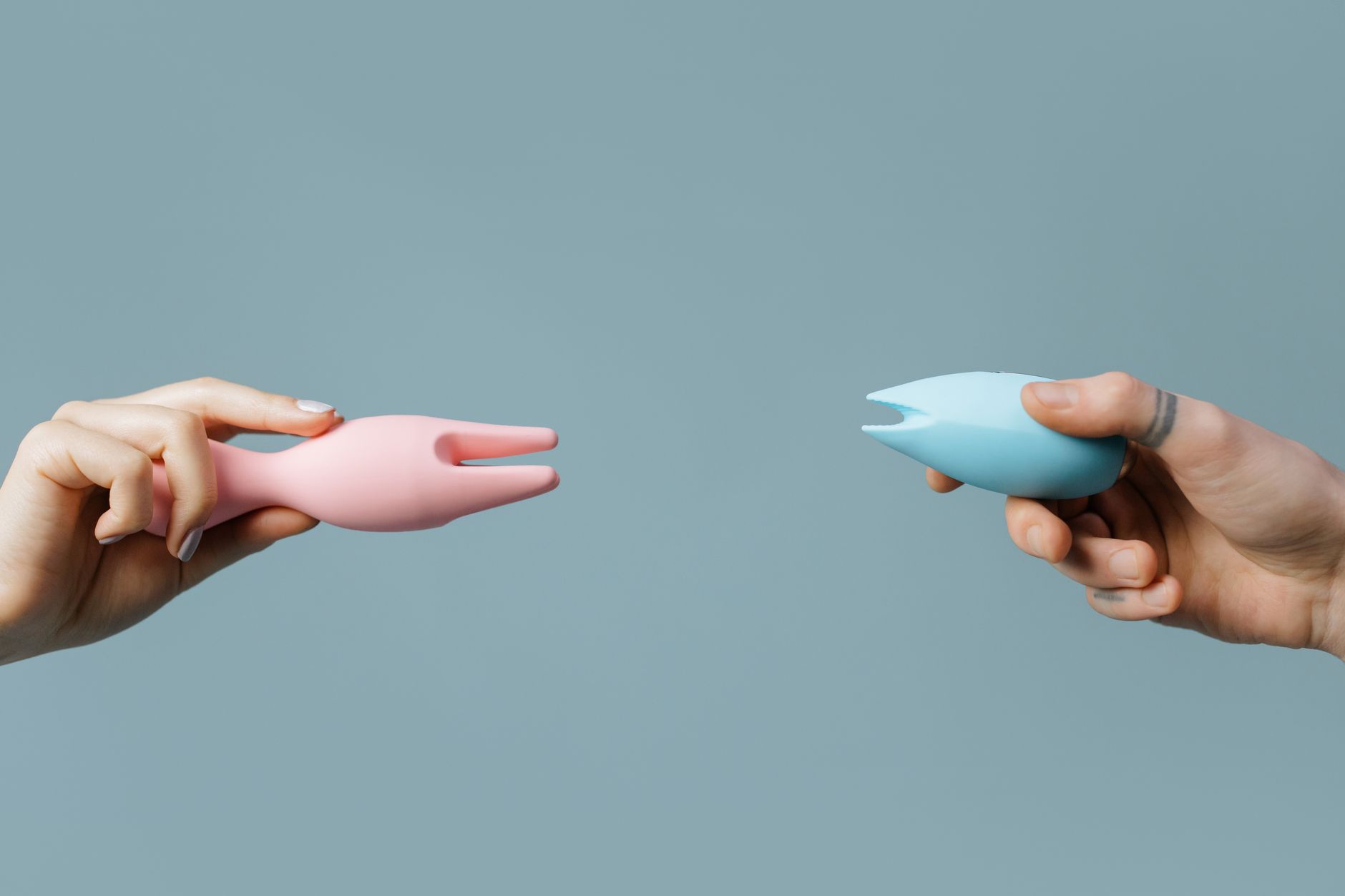
Photo by cottonbro studio on Pexels
The second time is easier
Once you've done it once, the weirdness budget is spent. You both know it's not a disaster. You both know the general shape of what happens. The second time, you can be more playful. You might ask them to try a different pattern. You might use it together on yourself while they watch. You might incorporate it into foreplay differently.
Some couples find that using a lemon clitoral vibrator together becomes a regular part of their intimate routine. Others use it occasionally, or only in certain contexts. There's no right frequency. What matters is that you're both choosing to be there.
If your partner still feels uncomfortable
Some people just don't vibe with toys, and that's valid. Not everyone wants to incorporate them into partnered sex. If your partner consistently feels uncomfortable, don't push.
But do ask why, without defensiveness. Is it a values thing? A sensory thing? A 'I feel less important' thing? The reason matters because it tells you what actually needs addressing. You might not be able to fix it, and that's okay. You might need to use a lemon vibrator solo instead, and your partner respects that boundary.
What matters is that you had the conversation and honored what came up.
The permission both of you need
Here's what I tell couples: your pleasure is not a threat to your partner. And your partner's involvement in your pleasure is not a replacement for their own contribution. These can both be true.
You're allowed to want something that feels good. Your partner is allowed to not know how to give it to you automatically. And a tool like a lemon vibrator is just that. A tool. It's not less intimate because it's shared. It's different, and different can be really good.
People also ask
Can I use a lemon vibrator if my partner is watching but not participating?
Absolutely. Some people want their partner present but hands-off. That's valid. The presence itself is intimate. You're being vulnerable in front of them. They're honoring your pleasure by witnessing it. There's nothing wrong with that dynamic.
What if I orgasm with the vibrator but not with my partner?
That's extremely common and not a reflection on your partner or your relationship. Different stimulation creates different outcomes. Orgasm with a vibrator is often faster because the sensation is more targeted. Orgasm with your partner might be slower, or might not happen at all, and both are fine. The goal isn't matching orgasm achievement. The goal is both people feeling good.
Should I hide my vibrator after sex or leave it out?
Leave it out. Treating it like contraband makes it weird. It's a toy. It lives somewhere. Some couples keep it on the nightstand, some in a drawer, some in a specific spot. Make it normal and it becomes normal.
How do I know if my partner actually wants to use the vibrator or is just doing it for me?
Ask them directly. 'Are you doing this because you want to, or because you think I want you to?' and then believe their answer. If they're doing it only for you and not enjoying it, that dynamic will eventually drain something from your connection. Better to know now and find a compromise.
What if my partner wants to use a vibrator on themselves while we're together?
That's their choice and their pleasure. If you feel uncomfortable, that's data worth exploring. Are you worried about being excluded? Worried about comparison? Just not used to it? All of those are worth discussing. You might find that watching becomes part of what you both enjoy.
How often should we use a lemon vibrator together?
There's no prescription. Some couples use it every time. Some monthly. Some when someone is stressed or having trouble with sensation. The frequency depends on what both of you want. Check in occasionally. 'Are you still enjoying this?' is a fair question to ask.
The real thing happening here
When you can be awkward with someone and keep going anyway, that's trust. When your partner can say 'I don't know what I'm doing' and you can laugh together instead of getting frustrated, that's intimacy. When a lemon vibrator sits on your nightstand without shame, that's freedom.
Your partner wanting to participate isn't pressure. It's an offering. Meet them there, be awkward together, and watch what unfolds. You'll both be surprised by what's possible when someone really wants to learn how to touch you.
Have questions about navigating intimacy with your partner? Reach out to our team. We're here to help.